
In this in-depth guide, you’ll find everything you need to know about babysitting costs in France, from teenage sitters to professional nannies. Average hourly rates, how much to pay based on age, experience, and location, and how extra tasks can impact the rate.
According to recent data, the average hourly rate for babysitters is between €10.50 and €13.00. Whether you’re hiring a secondary school student for occasional care or a qualified early childhood professional, babysitting rates vary depending on the region, experience, and type of care. This guide will help you make sense of it all: you’ll find average hourly rates, concrete examples, and practical advice for setting a fair, safe, and respectful rate for your babysitter.
Average Babysitting Rates in France
According to recent data, the average hourly rate for babysitters is between €10.50 and €13.00. However, rates can vary depending on:
- The city or region
- Paris & Île-de-France: €12–€16/h
- Lyon, Marseille, Bordeaux: €11–€13/h
- Smaller towns / rural areas: €9.50–€11/h
- The babysitter’s experience and age
- Qualifications (first aid, CAP petite enfance…)
- The number and age of the children
- The type of babysitting: daytime, evening, occasional or regular
On Sitly, you can browse the profiles of babysitters available in your area and see the going rates, or post a listing stating the rate you’re offering.
Rates and the Legal Minimum Wage
Babysitters and nannies must be paid at least the SMIC if they meet certain conditions:
- Formally employed, with regular hours
- Declared via CESU (Chèque emploi service universel) or another legal scheme
- Not family members or volunteers
In addition to the legal minimum wage, the Convention collective des particuliers employeurs et de l’emploi à domicile (IDCC 3239) also applies when the babysitter is regularly employed by a family. This agreement sets the rules for the employment contract: paid leave, overtime, evening work, or public holidays.
In some cases, the minimum pay may be higher than the plain SMIC. For example, if the babysitter has a qualification or a lot of experience, if she is looking after several children, or if she carries out additional tasks such as preparing meals or helping with homework.
Gross Hourly SMIC as of 1 January 2026
| Age | Gross hourly rate |
|---|---|
| 18 and over | €12.02 |
| 17 | €10.82 |
| 16 | €9.62 |
For informal or occasional care, even if the legal SMIC doesn’t apply, it’s still essential to offer a fair and respectful rate.
Average Rates by Region
| Region | Average hourly rate | Notes |
|---|---|---|
| Paris & Île-de-France | €12.00–€16.00 | High cost of living, strong demand |
| Major cities (Lyon, Marseille, Bordeaux, Lille) | €11.00–€13.00 | Competitive urban areas |
| Mid-sized cities (Nantes, Strasbourg, Grenoble…) | €10.00–€12.00 | Slightly lower than major cities |
| Small towns / rural areas | €9.50–€11.00 | Lower demand and cost of living |
Payment: Hourly or Flat Rate?
Hourly rate: recommended for occasional care, variable schedules, or last-minute requests. It allows each hour worked to be paid precisely and keeps things compliant with the legal SMIC when the care is declared.
Flat rate: can work well for fixed schedules or simple care (for example, an evening where the children are already asleep). It’s important to clearly define what the flat rate includes, such as the number of children, planned tasks, meals, and transport, and to provide for additional pay in case of extra hours or responsibilities.
Tip: clarify these details from the outset to avoid misunderstandings and ensure a professional relationship.
Experience and Qualifications Influence Rates
A babysitter’s experience, training, and certifications have a direct influence on their rate, and that makes complete sense. Age isn’t the only factor:
Trained or certified babysitter (CAP Petite Enfance, PSC1…) → €13 to €16/h depending on the city and responsibilities.
15-16 year old babysitter with regular experience → a rate slightly above the legal minimum.
Younger children → increased responsibility, hourly rate adjusted accordingly.
As a general rule: the more qualified the babysitter, the higher their rate will be. This is a personal decision. As a parent, you’re free to choose what best suits your situation:
Would you rather trust someone just starting out, with a more affordable rate?
Or are you looking for a profile with solid experience, for greater peace of mind?
There’s no universal answer, only an agreement that works for both parties.
Example: Babysitter (18 years old) – 3 children + dinner preparation
Sarah is 18 years old and has several years of babysitting experience. She is currently studying for a CAP Petite Enfance (early childhood care qualification) and holds a paediatric first aid certificate.
Once a week, she looks after three children (ages 8, 5, and 3) for the same family. She arrives at 4pm, picks the children up from school and daycare, then brings them home. She handles snack time, organises games, and prepares dinner. The parents return at 6:30pm.
What’s a Fair Rate for Sarah? Breakdown of her rate:
- Rate: €15.50/hour (reflecting experience, training, and managing three children)
Duration: 2.5 hours
Total: €15.50 × 2.5 = €38.75
Household Chores and Light Housekeeping
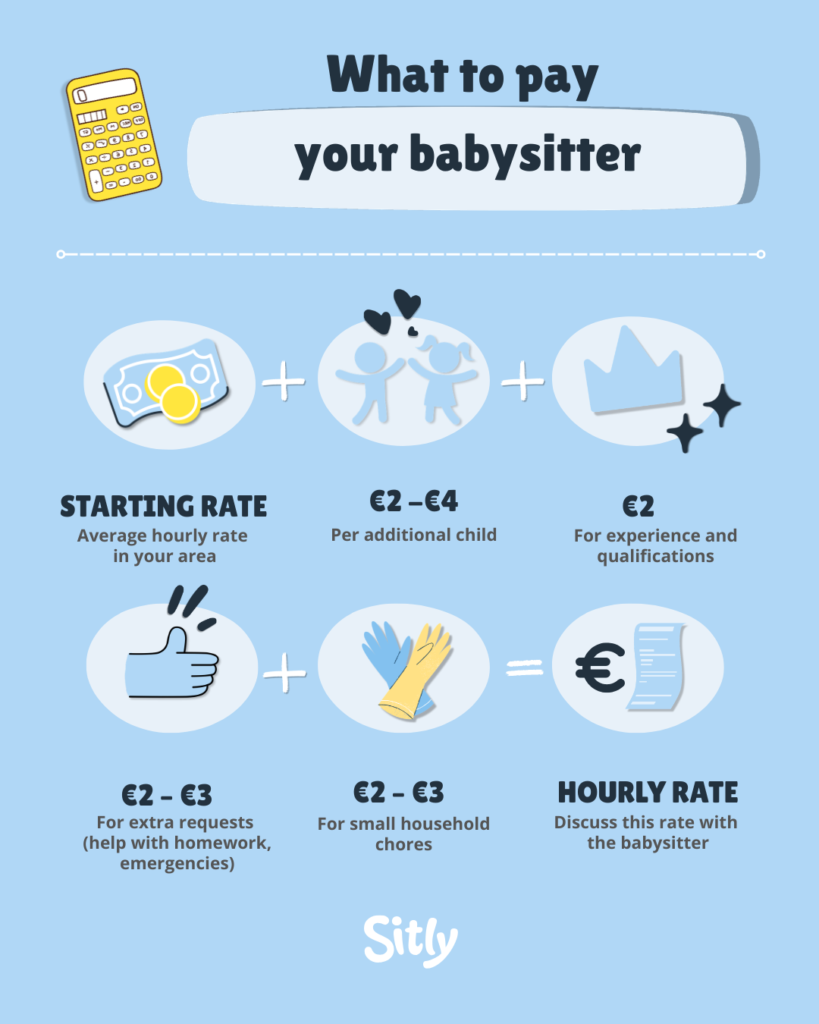
If your babysitter carries out a few household chores in addition to childcare (folding laundry, tidying up, preparing meals, etc.), it’s entirely reasonable to adjust their hourly rate upward. Their main role remains caring for and keeping the children safe, but these additional responsibilities take time and energy and should therefore be reflected in their pay.
For reference, in France, a declared housekeeper (via CESU) typically earns between €13 and €18 per hour, depending on the region and experience. When your babysitter combines childcare with light housekeeping, their hourly rate should therefore sit above that of standard babysitting, to reflect the full scope of work carried out.
Tasks that may justify a higher rate:
- Vacuuming communal rooms
- Loading or unloading the dishwasher
- Folding or sorting laundry
- Washing up after meals
- Preparing dinner for the children or the family
These responsibilities require time, energy, and focus. It’s therefore recommended to discuss expectations clearly and adjust pay accordingly. Check out our Babysitter Rate Calculator to get an idea of what to pay your babybsitter based on where you live and the type of help you need.
Evening Babysitting vs. Daytime Babysitting
Does your babysitter come only in the evening, or does she also help you after school? Evening care is often better paid, especially when it includes:
- Preparing dinner
- Bath time and the evening routine
- A late presence or overnight care
Daytime care, on the other hand, generally includes:
- Picking the children up from school
- Preparing snacks or meals
- Supervising playtime
- Managing bath time and the bedtime routine
In some cases, a flat evening rate can be agreed, or a reduced rate after a certain time if the children are already asleep.
Tip: if the babysitter arrives at 8:30pm and the children are already in bed, it’s common to offer a slightly lower rate from that point onward, while still valuing her presence and availability.
Example: 16-Year-Old Babysitter – 2 Children, Weekend Evening Care
Lia, 16, in Year 11 (seconde), has experience with her brother and cousins. She looks after two children on a weekend evening from 7:30pm to 11:30pm. The parents ask her to empty the dishwasher and drive her home afterwards.
What’s a reasonable rate for Lia?
- SMIC 2026: €9.62/h
+€1/h for the second child → €10.62/h
Flat rate agreed: €10/h → €10 × 4h = €40
Last-Minute or “On-Call” Babysitter Availability
Need a babysitter at the last minute? This kind of flexibility often comes at a cost. A spontaneous booking, especially in the morning or in an unforeseen situation, can force the babysitter to cancel her own plans or rearrange her day. In this case, it’s entirely appropriate to offer a slightly higher hourly rate, for example +€1 to +€2/h, to compensate for the inconvenience and show your appreciation. Her availability makes your life easier, so it’s worth valuing it.
Example: 21-Year-Old Babysitter – 1 Child, School Pickup + Lunch
Nina is 21 and currently studying Early Childhood Education. She holds a paediatric first aid certificate and has a flexible university schedule this semester.
Every Wednesday afternoon, she looks after one child for a regular family. She picks up the 6-year-old boy from school at 3:00pm, prepares lunch, plays with him, and stays until the parents return around 6:00pm. The child is very active, so Nina stays engaged the whole time. The family provides all the lunch ingredients and reimburses small expenses like bus fare or snacks.
What’s a reasonable rate for Nina?
- Base rate: €13/hour
+€1/hour for training and first aid → €14/hour
3 hours × €14 = €42
What’s the Right Rate to Pay a Babysitter in France?
There’s no single figure: the rate depends on several factors, including:
- The babysitter’s age, experience, and qualifications (early childhood diploma, first aid…)
- The number and age of the children being cared for
- Additional tasks (meals, homework help, light housekeeping…)
- The timing of the care (afternoon, evening, night)
- Location (higher rates in Paris and major cities than in rural areas)
- Your budget and expectations
Key to success: clear communication and mutual agreement. Be transparent about your needs and expectations. An open discussion helps set a fair rate and build a lasting relationship of trust.
Discussing Pay with Your Babysitter
Once you’ve estimated a rate, it’s essential to discuss it openly and transparently. Even for a first hire, this clarity helps avoid any misunderstanding. An honest discussion builds a relationship of trust and encourages the babysitter to stay motivated and reliable.
Start by asking the babysitter if she already has a rate in mind, then listen to her expectations and set out your own. Listen to her expectations and explain yours.
Table of contents
Trusted sitters, right around the corner
Need a little help? Sitly connects you with experienced babysitters in your area. Whether you need occasional or regular care, finding the right babysitter is super easy. Browse profiles, read reviews, and reach out to your favorites right away.

Related Articles

When is a baby old enough for a babysitter?
Wondering when your baby is old enough for a babysitter? While there’s no single “right” age, short and gradual separations are possible even in the early months when the babysitter is experienced and routines are respected.
Calculate Your Babysitter’s Rate with the Sitly Calculator
Find out how much to pay a babysitter in your area. Sitly’s Babysitter Rate Calculator shows average rates across France and helps you estimate a fair hourly wage based on your city, number of children, and any extra duties.

10 Ways to Help Your Child Overcome Fear of Monsters at Bedtime
If your child is afraid of monsters at bedtime, you’re not alone. Many kids aged 3 to 6 struggle with nighttime fears fueled by imagination and change. In this article, you’ll learn why these fears happen, how to validate them, and 10 simple, creative ways to help your child feel safe and sleep peacefully. From using nightlights and comforting routines to anti-monster sprays, magic spells, and stuffed animal bodyguards—each idea is designed to reduce anxiety and empower your child at night.